
Learning Center / Security Surveillance
Beyond the Camera: How AI-Powered Drones Are Changing Property Security
Exploring how autonomous aerial surveillance can complement traditional security cameras, guard patrols, and professional monitoring.
The Challenge: Securing More Property Without an Unlimited Budget
Imagine you're responsible for securing a 30-acre commercial property.
At the center of the property is a maintenance facility containing valuable equipment, tools, and machinery. Elsewhere, there may be storage buildings, material yards, access roads, and perimeter fencing.
Like most businesses, you have a security budget to work within.
Naturally, you prioritize protecting your highest-value assets. You install surveillance cameras around the maintenance facility, building entrances, and other critical locations.
But what about the rest of the property?
Installing cameras across every acre could require additional poles, electrical infrastructure, network connectivity, and ongoing maintenance. Even with an extensive camera system, buildings, equipment, vegetation, and other obstacles can create blind spots.
One common solution is to supplement the camera system with security guard patrols.
A guard may walk or drive the property every 30 minutes, every hour, or several times throughout the night, checking buildings, fences, storage areas, and other vulnerable locations.
It's a proven approach, but it has limitations.
A security guard can only observe what is visible from their current position. Buildings, stored materials, and poor lighting can obstruct their view. And once the guard moves to another location, the area they just inspected is no longer under direct observation.
Frequent patrols also introduce recurring labor costs, particularly when a large property requires multiple personnel or extended coverage.
So how do you expand security coverage without installing cameras everywhere or dramatically increasing your guard patrol budget?
An emerging answer is AI-powered aerial surveillance.
A Different Perspective: Security From Above
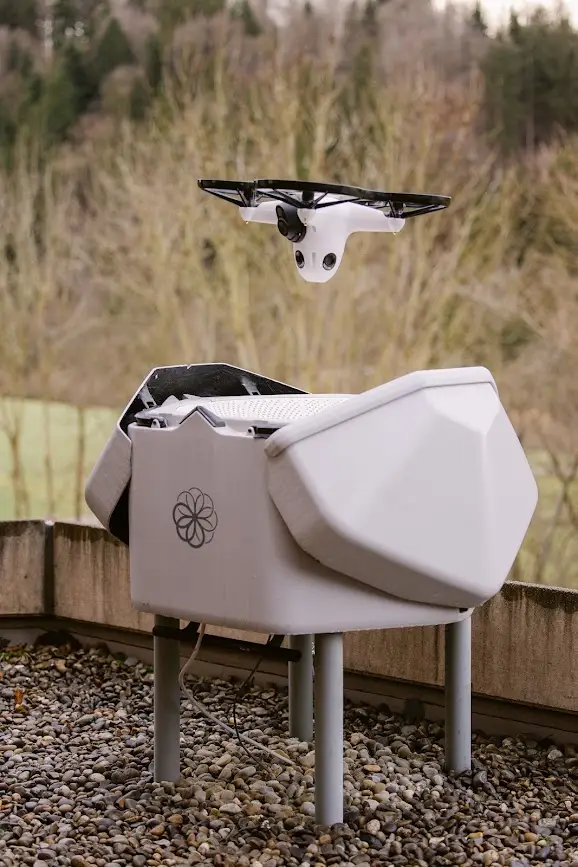
Imagine that same property equipped with an autonomous-capable security drone operating from a dedicated docking station.
Rather than relying exclusively on ground-level patrols, the drone can be programmed to follow predetermined flight paths around designated areas of the property.
For example, the system could be configured to conduct scheduled aerial patrols, subject to operational and regulatory requirements.
During each mission, the drone follows its assigned route, inspecting perimeter fencing, equipment yards, access roads, and other designated locations.
Its elevated perspective provides visibility into areas that may be difficult to observe from the ground.
Live aerial video can be transmitted to security monitoring personnel, providing additional information about activity occurring across the property.
When the mission is complete, the drone returns to its docking station, lands, and recharges in preparation for its next scheduled patrol.
The result is an additional layer of security that can complement existing surveillance cameras and traditional guard services.
Importantly, scheduled aerial patrols provide periodic observation rather than continuous coverage of every location.
How Artificial Intelligence Changes Drone Surveillance
Traditional drones generally require an operator to control or direct their movements during a mission.
Modern autonomous drone security systems introduce capabilities that can automate portions of this process.
Depending on the technology and configuration, these systems can support:
- Scheduled patrols: Predefined aerial inspections conducted at designated intervals.
- Automated flight paths: Repeatable routes that inspect specific areas of a property.
- AI-assisted detection: Technology that can identify and track objects such as people and vehicles.
- Event-triggered missions: Integration with compatible security systems that can initiate a drone mission when certain conditions are detected.
- Live video transmission: Real-time aerial imagery available to authorized security personnel.
- Automated docking and charging: The ability to return to a docking station and recharge between missions.
These capabilities allow drones to perform repeatable observation tasks while reducing the need for continuous manual flight control.
However, autonomous flight does not mean operating without human responsibility or regulatory oversight. Drone missions must comply with applicable FAA requirements and the authorizations governing each deployment.
Drones and Security Guards: Working Together
One of the most important things to understand about autonomous drone surveillance is that it is not intended to replace every function performed by a security guard.
Security personnel provide capabilities that drones cannot.
A guard can physically investigate an incident, assist individuals, control access points, communicate with people on-site, and respond directly to situations requiring human intervention.
A drone cannot perform those tasks.
What a drone can do is provide additional observation capabilities that may reduce the need for personnel to conduct certain repetitive inspection routes.
Consider a large commercial property requiring frequent perimeter patrols.
Rather than assigning guards to repeatedly travel the same route, an organization may be able to use scheduled aerial inspections for some routine observation tasks while keeping security personnel available for activities requiring direct human involvement.
This approach can potentially improve how security resources are allocated.
Instead of asking whether drones should replace guards, a more useful question is:
Which security tasks require a person on the ground, and which observation tasks could benefit from an aerial perspective?
The answer will vary depending on the property, its risks, operating environment, and security requirements.
The Value of Live Security Monitoring
AI-powered surveillance becomes more useful when it is combined with professional human monitoring.
Artificial intelligence can help identify activity, but identifying an object is not the same as understanding whether it represents a security threat.
For example, a drone may detect a vehicle traveling through a storage yard after normal business hours.
That vehicle could belong to an authorized employee, a maintenance contractor, or someone who should not be on the property.
AI can assist with detection and tracking, but trained security personnel are better positioned to evaluate the circumstances using available video, site instructions, and established response procedures.
MSC's monitored drone-enabled security solutions incorporate live video monitoring by U.S.-based security personnel.
This allows aerial video to complement the information available from traditional surveillance cameras.
Depending on the circumstances and customer-specific procedures, monitoring personnel can evaluate activity and coordinate an appropriate response.
The drone pilot and security monitoring personnel perform distinct functions, with flight operations conducted under applicable aviation requirements.
The objective is to combine intelligent technology with informed human decision-making.
Real-World Application: Large Commercial and Industrial Properties
Large commercial properties often contain multiple areas with different security priorities.
A manufacturing facility might have high-value equipment inside its main building, outdoor storage areas, employee parking, loading docks, and perimeter fencing.
Traditional cameras may provide excellent coverage of the building and critical equipment.
However, extending the same level of surveillance throughout the entire property may be cost-prohibitive.
An autonomous-capable drone can provide scheduled aerial inspections of selected secondary areas, complementing the continuous coverage provided by fixed cameras.
This approach may be particularly useful for properties with large outdoor areas, changing storage configurations, or locations that are difficult to observe from ground level.
Real-World Application: Construction Sites and Infrastructure Projects
Construction projects introduce another set of security challenges.
Unlike a permanent commercial facility, a construction site changes as work progresses.
Equipment moves, materials are relocated, temporary access roads are created, and active work zones shift.
Consider a highway construction project extending along a significant section of roadway.
The contractor may have a central equipment storage yard containing excavators, loaders, generators, tools, and other valuable assets.
Traditional security cameras can protect that staging area.
However, additional equipment, materials, and work zones may be distributed throughout the project.
Monitoring every location with permanent surveillance infrastructure may be impractical.
Drone-assisted aerial surveillance introduces another option.
Where flight range, airspace restrictions, and site conditions permit, a drone can conduct scheduled inspections of designated construction areas and equipment locations.
As the project progresses, patrol routes may be adjusted to reflect changing security priorities.
For large or geographically extended projects, multiple docking locations or other security measures may still be necessary.
The benefit is flexibility: aerial surveillance can become part of a security strategy that adapts as the project evolves.
Understanding the Economics of Aerial Surveillance
Security decisions are rarely based on technology alone.
Cost, staffing, infrastructure, maintenance, and operational requirements all influence the final solution.
Traditional fixed cameras provide dependable continuous surveillance of designated areas, but expanding coverage may require additional electrical and communications infrastructure.
Security guard patrols provide human judgment and physical response capabilities, but frequent patrols create ongoing staffing expenses.
Autonomous drone systems introduce their own costs, including equipment, docking infrastructure, pilot oversight, maintenance, monitoring, and regulatory compliance.
Consequently, aerial surveillance is not automatically the least expensive option.
Its potential value comes from providing another method of inspecting multiple locations, particularly where installing additional fixed cameras or conducting frequent ground patrols may be inefficient.
A well-designed security program evaluates these options together rather than treating them as competing solutions.
Important Considerations Before Deploying Drone Surveillance
Although AI-powered aerial surveillance offers promising capabilities, it is not appropriate for every property or application.
Several factors must be evaluated before deployment.
FAA Requirements: Commercial drone operations must comply with applicable aviation regulations, airspace restrictions, and operational authorizations.
Flight Range and Duration: Drones have operating limits that determine how much territory can be inspected during an individual mission.
Weather Conditions: Wind, rain, visibility, and other environmental conditions may affect flight availability.
Nighttime Surveillance: The ability to observe activity in low-light environments depends on the aircraft's imaging equipment and operating conditions.
Privacy and Data Protection: Drone operations should account for applicable privacy requirements, appropriate camera use, and responsible handling of recorded video.
Human Oversight: Autonomous technology still requires appropriate operational supervision, system management, and response procedures.
Understanding these considerations is essential when determining whether drone surveillance is a practical addition to an existing security program.
The Future of Security Is Integration
For decades, commercial security strategies have relied on several fundamental components: physical security, surveillance cameras, intrusion detection, access control, security personnel, and professional monitoring.
AI-powered aerial surveillance introduces another capability to that established framework.
Rather than replacing traditional security measures, it can connect with them.
Fixed cameras continue monitoring critical areas. Intrusion detection systems identify potential security events. Access control systems manage authorized entry. Security personnel provide human judgment and physical response.
Autonomous-capable drones can add an aerial perspective, providing another way to inspect locations that may be difficult or expensive to monitor using traditional methods alone.
The result is a more flexible approach to protecting complex properties.
The future of commercial security is not simply about installing more cameras or deploying more technology.
It's about using the right combination of security tools to address the risks of each property.
Frequently Asked Questions
Can autonomous security drones replace security guards?
Not entirely. Autonomous drones can supplement guard patrols by performing certain aerial observation tasks, but they cannot physically intervene, assist individuals, or perform many duties requiring on-site personnel. Depending on the application, drones may help reduce the frequency of some routine patrols or allow security personnel to focus on higher-priority responsibilities.
Can security drones automatically patrol a property?
Yes. Certain autonomous drone security systems support scheduled missions along predefined flight paths. The specific capabilities and permissible operations depend on the system configuration, site conditions, and applicable FAA requirements.
Can drones respond to security alarms?
Some autonomous drone platforms support integration with compatible security systems, allowing drone missions to be initiated by configured events. Availability depends on the equipment, integration, and operational authorizations.
Are security drones useful for large construction sites?
They can be. Aerial surveillance can provide additional visibility across equipment yards, storage areas, access roads, and changing work zones. Flight range, docking locations, airspace restrictions, and operating conditions determine which portions of a project can be inspected.
Is drone surveillance less expensive than hiring security guards?
Not necessarily. The economics depend on property size, required patrol frequency, staffing, equipment, maintenance, monitoring, and aviation compliance costs. Drone surveillance may reduce certain repetitive patrol requirements, but it should be evaluated as part of the overall security budget.
Can security drones operate at night?
Some commercial security drones support nighttime operations, depending on their imaging equipment, lighting conditions, and applicable operating requirements. Nighttime surveillance capabilities should be evaluated for each deployment.
Exploring Aerial Surveillance With MSC Integration
At MSC Integration, we believe effective security begins with understanding the property, identifying its vulnerabilities, and selecting the right combination of technologies to address them.
AI-powered aerial surveillance represents an emerging opportunity to expand the capabilities of traditional commercial security systems.
Whether you're protecting an industrial property, managing a large construction project, or evaluating ways to improve security coverage without significantly increasing staffing requirements, aerial surveillance may be worth considering.
MSC Integration works with businesses to evaluate integrated security solutions, including video surveillance, intrusion detection, access control, AI-powered technology, and professional monitoring.
Interested in learning whether aerial surveillance could complement your existing security system?
Contact MSC Integration to discuss your property's security challenges and explore available options.